The nurse-led software company.
Nightingale OS is built, led, and owned by nurses — the profession held accountable when systems fail. When an algorithm is wrong, the nurse who followed it answers to a licensing board and the vendor who sold it holds no license at all. We built the company on the side of the license. That is not a branding choice. It is our operating model, our moat, and our cap table.
Expertise the incumbents
can't hire back.
Every hospital software company employs engineers. Almost none is led by the people its software governs. The judgment that decides what Charlie Owl refuses, cites, and receipts comes from the bedside — trauma-informed clinical practice, survey seasons lived firsthand, standards read the way a surveyor reads them. That knowledge is expensive to imitate and impossible to shortcut: you cannot sprint your way to a decade at the bedside. It is also the least-served expertise in the building — a nurse crosses six to twelve systems in a single shift to make one plan of care hold, and KLAS finds only 12% of nurses rate their EHR “Elite,” against 22% of physicians. The people doing the integrating are the buyer, and we sell to them nurse to nurse.
Clinical judgment sets direction
Product decisions start with what the standard actually requires and what the bedside actually does. Engineering serves that judgment — not the other way around.
Refusals designed by the accountable
A nurse knows which corners must never be cut, because nurses are the ones held to account when they are. That is why every refusal names its policy and keeps its receipt — the same record that, in the AI suits now moving through discovery, is the only thing that has actually worked as a defense.
Trust that can't be bought
The buyer is a nurse, and this product is sold nurse-to-nurse by the company that is structurally on their side. An incumbent can copy a feature; it cannot copy whose side the architecture is on.
Built so it can't be turned on the people who do the work
Anything the platform computes about nurses is worker-side by architecture: manager-facing rollups suppress below k ≥ 5, so no cell resolves back to a person. A nurse-owned company is the only kind that would make that a constraint instead of a setting.
The profession that carries the
accountability keeps the equity.
Ownership at Nightingale OS is earned by nurses. We hire from the bedside diaspora, and equity accrues to the practicing clinicians and collaborators who bring their judgment into the product — the registrars, quality nurses, and educators whose expertise becomes the software's spine.
When the company wins, the profession that made it credible owns the win. That alignment is the point: the people accountable for care should hold a stake in the tools that govern it.
Live in weeks, not years.
Charlie Owl is a web app. No EHR integration is required to start — an organization can go live in a few weeks, and the technical expertise needed for implementation simply works alongside the hospital's own IT team.
For go-lives, we engage technical implementation specialists — concentrated exactly where deep technical skill has the highest impact, and nowhere else. This inversion distills expertise to where it matters most: clinical judgment shapes the product every day, implementation specialists appear at the moment of go-live, and your IT team keeps control of your environment.
Week zero
Access and accounts, set up alongside your own IT team. A browser is the footprint.
The build weeks
Your compliance surfaces configured, your evidence loaded, your named attesters in place — guided by nurses who have run survey seasons.
Go-live
Implementation specialists on hand for the cutover, then a running system your team owns. The receipts start accruing on day one.

Built by clinicians who
hold the license.
Nightingale OS was founded by a 20-year ER, Flight, and Trauma Nursing veteran who spent two decades running hospital trauma and accreditation programs. She has sat inside the surveys that decide designations — including two CDPH survey visits where her own performance was material to the plan of correction. The standards in Charlie Owl are read the way a surveyor reads them because she has been in the room when the reading counted.
She is a primary contributing author across the Emergency Nurses Association’s trauma curricula — the Trauma Nursing Core Course provider manual (8th ed.), the ENA Advanced Course on Trauma, and the Emergency Nursing Core Curriculum (8th ed.) — and a former Stanford educator. She taught herself to build by directing AI coding agents inside a governance harness she authored — which is why the governance is the architecture here and not a policy document laid over it. The equity model follows the same logic as the product: the profession that carries the accountability keeps the ownership.
An educator by profession and a thought leader by record — and like everything else here, the record comes with receipts:
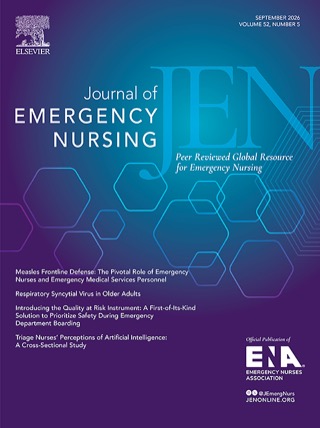 Just published · September 2026
Tinkerbell Moments: Reframing Emergency Department Relational Collapse Through a Neurobiological Lens
Journal of Emergency Nursing, Vol. 52, No. 5 — the Emergency Nurses Association’s peer-reviewed journal. A clinical framework for reading “difficult” patient behavior as evidence of system design failure, with four bedside tools nurses can use on the next shift.
Read the article →
Just published · September 2026
Tinkerbell Moments: Reframing Emergency Department Relational Collapse Through a Neurobiological Lens
Journal of Emergency Nursing, Vol. 52, No. 5 — the Emergency Nurses Association’s peer-reviewed journal. A clinical framework for reading “difficult” patient behavior as evidence of system design failure, with four bedside tools nurses can use on the next shift.
Read the article →
The national curricula
Primary contributing author, Emergency Nursing Core Curriculum, 8th ed. (Elsevier, 2026); the Trauma Nursing Core Course provider manual, 8th ed.; and the ENA Advanced Course on Trauma. Author, the Solheim Critical Care Transport Certification Exam Review, 3rd ed.
Peer-reviewed & honored
Published in the Journal of Emergency Nursing (2026, “Tinkerbell Moments”; 2017) and Annals of Emergency Medicine (2022, pediatric patient safety in emergency care). Named to ENA Connection’s 20 Under 40 by the Emergency Nurses Association.
The public argument
Essays on the systems that fail clinicians, in the Bulletin of the Atomic Scientists and on KevinMD — the ER crisis, the shadow ledger of nursing turnover, health-care cyber-vulnerability — plus the KevinMD podcast and teaching the craft out loud on the Art of Emergency Nursing podcast: trauma-informed care in part one and part two, and the COVID-19 special.
On the record when it counted
When the VA failed to protect its frontline staff in 2020, she filed complaints with the inspector general and OSHA and went on the record — the subject of a ProPublica investigation and PBS NewsHour reporting on the system that failed its nurses. Saying the uncomfortable thing in public, with receipts, is the discipline this company sells.
Prior work: Color Study
An open-source image lab she built to explore faint color in cave paintings, ancient murals, and painted sculpture. Compare original and enhanced photographs, try your own images, and contribute to a public photo collection. Explore Color Study →